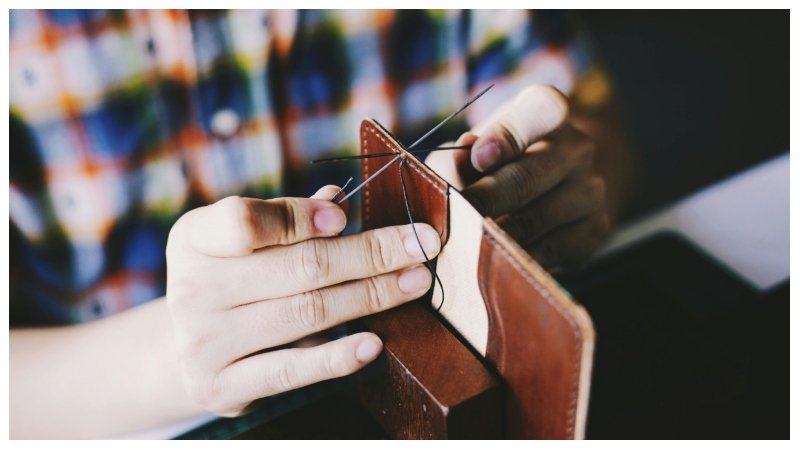
Step into a professional leather restoration studio or a bespoke saddlery, and the sensory experience is immediately dominated by heavy machinery. The equipment required to manipulate dense vegetable-tanned cowhide is massive. Workbenches are anchored by solid cast-iron stitchers, heavy steel speed reducers, and high-powered electric servo motors. When operators discuss their craft, they usually credit the precision of their steel needles, the strength of their bonded nylon thread, or the raw horsepower of their motors.
Yet, the true hero of this heavy-duty environment is almost never mentioned. It is not made of hardened steel or advanced digital circuitry. It is a simple, flexible loop of reinforced rubber connecting the motor to the handwheel. If this basic component fails, stretches, or loses its grip, the entire mechanical symphony collapses, and expensive materials are instantly ruined.
To understand why this loop of rubber is so vital, one must look at the intense physics of power transmission and the unique demands of sewing thick leather.
The Geometry of Grip
When a heavy-duty electric motor spins, it generates a massive amount of rotational force known as torque. However, torque is completely useless if it cannot be transferred from the motor located under the table up to the main drive shaft of the machine sitting on top.
In industrial setups, this transfer relies on a specialized trapezoidal geometry known as a V-belt profile. Unlike a flat band that simply rests on the surface of a wheel, a V-profile is engineered to wedge itself deeply into the grooved pulleys attached to the motor and the handwheel. As the motor applies tension, the wedge shape is pulled tighter into the groove. This creates an immense amount of lateral friction, ensuring that the heavy steel handwheel turns in perfect, lockstep synchronization with the electric motor below.
This absolute synchronization is non-negotiable when working with dense materials. A needle punching through three layers of saddle leather encounters severe physical resistance. The belt must grip hard enough to force the needle through the dense collagen fibers without a fraction of a second of hesitation.
The Silent Thief of Kinetic Energy
Because this component is subjected to constant friction, high speeds, and physical strain, it eventually begins to degrade. The degradation is usually invisible at first. Over hundreds of hours of operation, the rubber slowly stretches. The heat generated by friction can cause the sides of the belt to vulcanize and glaze over, turning the once-grippy rubber into a hard, slick surface.
When this happens, the system experiences a catastrophic loss of kinetic energy known as slippage. The operator presses the foot pedal, and the electric motor spins rapidly. However, the glazed rubber simply slides through the grooved pulley instead of gripping it.
For the artisan, this slippage is disastrous. If the belt slips just as the needle strikes the thick leather, the machine stalls mid-punch. The needle gets stuck inside the material. If the operator tries to force it, the needle can snap violently. Even if the needle survives, the momentary hesitation ruins the momentum of the machine, resulting in uneven stitch lengths and crooked lines that permanently disfigure luxury goods. Click here for more information.
The Ultimate Mechanical Fuse
Despite the frustrations of slippage, the rubber drive loop is intentionally engineered to be the most vulnerable part of the machine. In mechanical engineering, it acts as a sacrificial fuse.
Heavy-duty stitchers are filled with complex, expensive internal metal gears, oscillating shafts, and synchronized timing mechanisms. If an operator accidentally sews over a solid brass rivet or a hardened steel shank hidden inside a boot, the needle comes to a dead, violent halt. If the connection between the high-torque motor and the machine was made of a rigid steel chain, that massive kinetic energy would have nowhere to go. It would instantly sheer the internal metal gears, destroying a machine worth thousands of dollars.
Instead, when the machine hits an immovable object, the rubber belt absorbs the shock. It safely slips out of the groove or simply snaps, instantly cutting the power transfer and saving the internal mechanics from catastrophic destruction.
The Importance of Routine Calibration
Because of its critical role, professional artisans treat the drive loop with obsessive care. They constantly monitor the tension, seeking the perfect balance. If the tension is too loose, the machine lacks the punching power to penetrate thick hide. If the tension is too tight, it puts unbearable side-load pressure on the internal steel bearings, causing the machine to overheat and wear out prematurely.
Maintaining this flawless power transfer is the cheapest and most effective insurance policy in a workshop. Swapping out a degraded leather sewing machine belt ensures that the artisan retains complete, predictable control over their heavy-duty equipment. In a craft where precision is measured in millimeters and mistakes are permanent, the quality of the final product relies entirely on the invisible, reliable grip of a simple rubber loop.